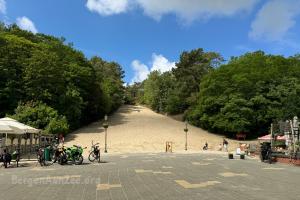
Old Bergen behind the dunes
Long before there was a village by the sea, the old village of Bergen, with a history of more than a thousand years, lay on the landward side of the dunes.
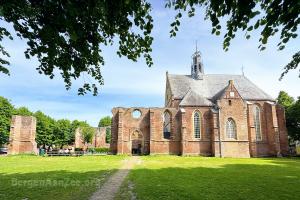
- A church in ruins: during the Eighty Years' War the church was largely burned down; only the choir survived and is still used as a church today.
- Battle of Bergen (1799): on 19 September 1799 fighting took place around Bergen during the Anglo-Russian invasion of North Holland, which was repelled by French and Batavian troops.
The Van Reenen family
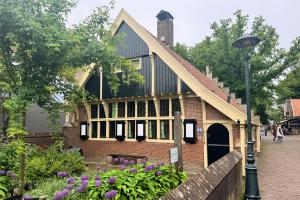
Bergen's rise as a seaside resort and artists' village is closely linked to the Van Reenen family, the lords of Bergen.
- Lords of Bergen (1851): in 1851 Jan Jacob van Reenen bought the seigniory of Bergen and settled at the Oude Hof, a 17th-century country estate.
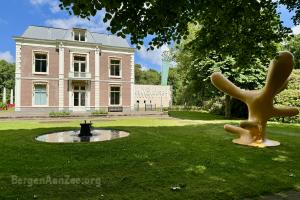
- Kranenburgh House: his son Jacob van Reenen built a villa in 1882 which, as Kranenburgh, became the mayor's residence when he became mayor of Bergen in 1885.
- A book about Bergen (1904): the mayor's wife, Maria van Reenen-Völter, wrote a book in 1904 about the beauty of Bergen, aimed especially at artists.
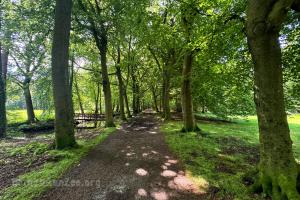
- The Zeeweg (1905): in 1905 the cart track through the Bergerbos and the dunes was replaced by a paved road to the sea, the Zeeweg.

A new village by the sea (1906)
The name Bergen aan Zee was already used in 1848 for an outpost in the dunes, but the actual village only arose in 1906 through private initiative.
- The first stone (1906): on 28 July 1906 the first stone was laid for Café Prins Maurits, which soon became the first hotel in Bergen aan Zee.
- Hospitality by the sea: the Zeiler family from Baarn saw opportunities for hotels and restaurants in the new resort.
- The tram (1909): mayor Van Reenen made sure the tram line from Bergen was extended to Bergen aan Zee in 1909.
- The Koloniehoek: in 1908 Het Zeehuis was built, a convalescent home for children from the Amsterdam orphanage, followed by colony houses in 1910 and 1912; the three buildings have been national monuments since 2001.
- A hundred years (2006): in 2006 the village celebrated its centenary in style.
Artists and the Bergen School
In the early 20th century artists discovered the nature and light of Bergen, and the village grew into a true artists' colony.
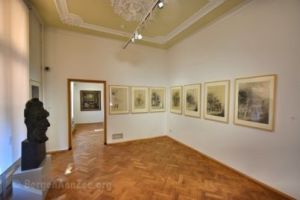
- A movement of its own: between 1915 and 1925 the Bergen School emerged here, with an expressionist style, cubist influences and dark tones.
- The founders: the French painter Henri Le Fauconnier and the Dutch painter Piet van Wijngaerdt were at its origin, and Charley Toorop, Leo Gestel and John Rädecker are also counted among the group.
- On the Buerweg: many of the painters lived close together on the Buerweg in the hamlet of Westdorp, between Bergen and Bergen aan Zee.
War and reconstruction
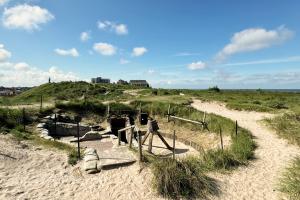
During the Second World War the coast became part of the German Atlantic Wall, and Bergen aan Zee did not escape it.
- Lost hotels: during the war the former Hotel Nassau, among others, was demolished.
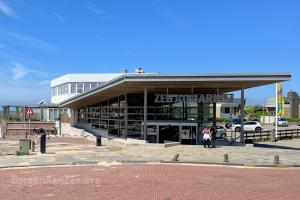
- The Zee Aquarium (1956): on the site of Hotel Nassau the Zee Aquarium opened in 1956, an idea that had first come up in 1954.
- A sperm whale: of the three sperm whales that washed ashore in 1998, the aquarium obtained one, whose skeleton is still on display.
The dunes and today's resort
Bergen aan Zee has remained a small seaside resort, surrounded by one of the most beautiful dune areas in North Holland.
- Protected dunes: the dunes around the village are part of the Noordhollands Duinreservaat, and the North Sea Trail runs through the village.
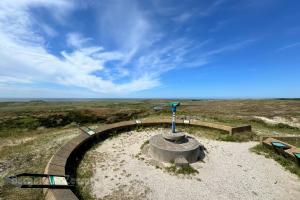
- De Kerf (1997): in 1997 an opening was deliberately cut in the foredunes north of the village, allowing seawater to flow back into the dune valley; you can see the result from the De Kerf lookout dune.
- The dune fire (2010): on 14 April 2010 a large dune fire threatened the village, and all residents were temporarily evacuated.
- Small but well loved: with around 370 inhabitants, Bergen aan Zee is a quiet village, popular with beachgoers, surfers and catamaran sailors.